
After the holiday, it will be a bit like being on an plane. Before you help the children, put the “oxygen mask” on yourself.

Take a breath. Slow down. Notice where you are.
A calm teacher creates a calm classroom—everything starts there. Before we ask how the children are, there is a quieter but very important question: How are we, the teachers? We also return after the holiday with many thoughts, plans, expectations—and sometimes with tiredness. We step into the classroom wanting everything to start “as it should,” but our body and heart are not quite there yet. And children feel this. They pick up on tension, rushing, hesitation just as easily as they pick up on calm and a smile.
That is why the first care in the first days is not the curriculum, but giving ourselves permission to slow down, to breathe, and to be truly present. Everything else begins from there. Learning comes after the child feels calm and accepted.
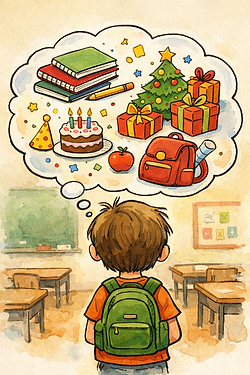
How children feel after the holiday
In the primary years, transitions are experienced strongly:
joy at seeing friends, mixed with mild anxiety
lower tolerance and stronger emotions
a sense that the group needs to “tune in” again
different speeds of adjustment—each child in their own way
This is not a lack of discipline or motivation. It is a child who is re-adjusting.
Calm opens the door to learning
The first days after a holiday are a time for safety and predictability. Children need to feel that:
the day has a clear rhythm
the adult is calm and consistent
their feelings are allowed
When a child feels seen and understood, attention and willingness to participate return much more easily.
Let’s remind ourselves how we work together
After a break, communication and cooperation skills need a gentle “refresh”:
how we listen to one another
how we share space and time
how we resolve small conflicts
Short pair activities, clear words about what “working together” means, and plenty of patience—this is more than enough for a beginning.
Interest brings children back to learning
When a child is interested, engagement comes naturally. Small choices, questions connected to personal experience, and opportunities to share all awaken curiosity.
Sometimes, instead of asking “How do we motivate them?”, it is more helpful to ask: “What at school can become important to them again?”
Social-emotional well-being is not an extra
It is the foundation on which learning stands.
When children feel calm, connected, and safe, they are ready to think, ask questions, and try.
Activity idea: “Welcome Back”
First: Together with the children, discuss how you will know that you have worked well—for example, we listen to one another, everyone has the right to share, we help each other.
Activity: “Our class—together again”
Students work in pairs.
Each pair draws or writes:
one positive experience from the holiday
one thing they are looking forward to at school
All drawings are collected into a shared poster and displayed in the classroom.
This is not just a poster. It is a quiet reminder that the classroom is once again a place for sharing, belonging, and growth.
When we give time for this transition, learning comes naturally. Children are not in a hurry—and we do not need to hurry for them.


Comments