
Learning Through Transdisciplinary Units: One Basket, Many Ways of Knowing

Updated: Jun 21
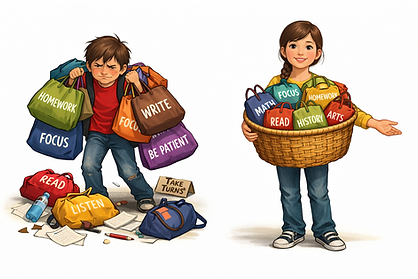
Transdisciplinary learning is often spoken about as something “nice for younger children.” Playful. Integrated. Manageable before the “real subjects” begin.
But this idea does a disservice to students of all ages.
All learners—regardless of grade—deserve the chance to explore a meaningful piece of the world through multiple perspectives. Not because it is easier, but because it is truer to how knowledge actually works.
The Invisible Load Students Carry
Imagine what school asks of a single child, every single day.
Focus. Read. Write. Bring homework. Listen. Cooperate. Be ready. Be patient. Take turns. Switch mindsets. Switch rules. Switch expectations.
Now imagine doing this separately in mathematics, literature, science, history, geography, arts, physical education. Different notebooks. Different criteria. Different language. Different definitions of success.
There is no way for one child to carry all of this without dropping something.
And this load does not disappear during breaks. Social navigation, emotional regulation, friendships, conflicts—all of these are carried too. None of this accounts for what students bring from home: family responsibilities, personal struggles, health, or simply being human.
When we fragment learning into isolated subjects with disconnected goals, we increase cognitive and emotional weight—especially for students who are already working at full capacity.
Cross-Curricular Learning Is Not “Less Rigorous”
A common fear is that integration waters things down. In reality, well-designed cross-curricular units do the opposite.
They reduce noise while increasing depth.
Instead of asking students to juggle unrelated demands, we ask them to return—again and again—to the same core ideas, questions, and contexts, each time through a different disciplinary lens.
This is not simplification. It is coherence.
One Basket: A Shared World to Explore
Imagine placing everything in one basket.
For example: The Industrial Revolution.
Not as a single chapter in history, but as a shared world students enter and explore.
Literature: Students read texts from or about the period. They examine how writers portray the lives of workers, children, factory owners, and reformers. They analyze voice, perspective, and bias. They write narratives, letters, or reflections grounded in historical reality.
History and Geography: Who were these people? Where did industrialization begin—and why there? How did geography shape access to resources, trade routes, and urban growth? How did migration change cities and societies?
Mathematics: Percentages, growth rates, production increases, population changes, working hours, wages. Numbers stop being abstract when they explain human experience.
Science: Energy sources, machines, materials, and inventions that powered industrialization. Cause and effect. Innovation and consequence.
Arts: Visual art, music, and design as responses to industrial life—celebration, critique, documentation. Students express understanding through creative media while grounding it in context.
Suddenly, students are not ”switching subjects.” They are deepening understanding.
Fewer Transitions, Deeper Thinking
Cross-curricular units reduce the constant cognitive reset that traditional schedules require.
Instead of asking:
“What do I need to do to succeed in this class?”
Students begin to ask:
“What am I learning about the world—and how can this subject help me understand it better?”
This shift supports:
executive function
sustained attention
transfer of learning
motivation and meaning
And importantly, it supports equity. When expectations align around a shared context, fewer students are left behind simply because they missed one instruction, one homework task, or one mental shift.
Integration Is an Act of Care
Cross-curricular learning is not only a pedagogical choice. It is an ethical one.
It acknowledges that children are already carrying enough.
By designing learning that connects rather than fragments, we say:
Your effort matters.
Your attention is precious.
Your understanding deserves time to grow.
We cannot remove all the weight students carry—but at school, we can choose how we ask them to carry it.
Sometimes, the most powerful thing we can do is stop handing them separate bags—and instead place everything carefully into one well-held basket.
Written by Radostina Dancheva
Curriculum developer, teacher trainer and founder of Idea Box.
Learn more about my journey and work →


Comments